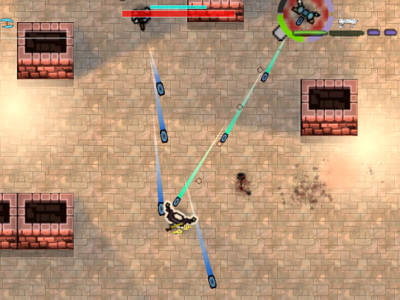

Part of my previous presentation at the Nationalist Art Conference was about the limitations of humour in video games. I specifically used the example of the Female Blacktivist character twerking on the player when they get close, which is funny the first time it happens. The second time, it’s mildly amusing. Thereafter it blends into the background as simply another form of damage.

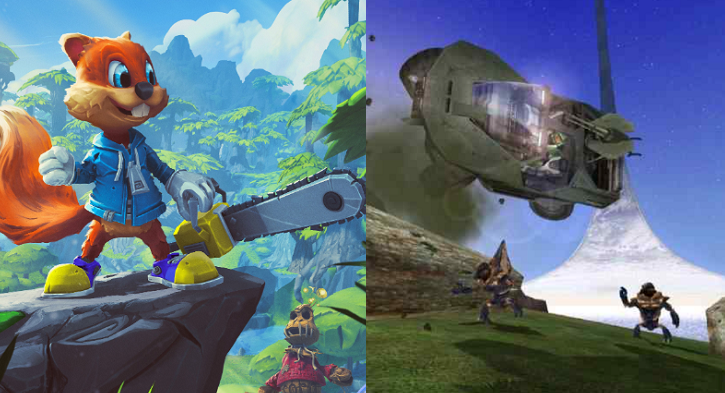
Gag humour can add to a game, if it lands. If it doesn’t, it can be downright painful. The worst example of the latter I’ve experienced is from the DeathSpank series, a derivative Diablo clone that featured – hold on to your panties because this is way out there – a protagonist who wears a thong! And when he charges into battle he says “I am DeathSpank!” in a silly voice. No doubt this caused swathes of players to lose progress, unable to control their hysterical laughter and react to the enemies. I was even funnier the thousandth time you heard it.
DeathSpank, while not nearly as nasty, reminds me of HBO’s aborted Velma remake. Even ignoring the anti-White misandryism, the entirety of the “humour” boiled down to the showrunners doing something derivative, before turning around and saying “wow, look how generic, boring, and non-sensical this thing is,” and expecting the audience to clap like trained seals.

The best satire I’ve ever seen works as both a parody and celebration of the source material. Where the work of fiction acknowledges that it’s silly, but is still earnestly trying to entertain you. Self-aware, but mocking neither itself nor the audience in lieu of originality.
So I don’t particularly enjoy that DeathSpank is a game chock full of generic, nondescript NPCs, and I don’t get much out of them constantly breaking the fourth wall and pointing out their own creative bankruptcy.
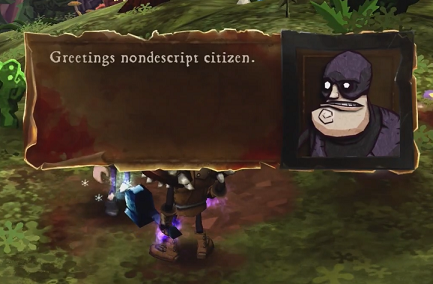
Isn’t it hilarious how uncreative we are?
I’d rather they just made interesting NPCs such as Alexei, a boss from Ninja Gaiden 2 who looks like if Derek Zoolander got possessed by a Slaanesh demon that was really into cosplaying and trenbolone. Alexei can be seen smooching the Statue of Liberty in the below cutscene, almost literally chewing the scenery during his villainous monologue to no one that the camera just happens to catch.
Ninja Gaiden 2 Strategy Wiki (Chapter 4 Synopsis):
Alexei has transformed the Statue of Liberty into his own twisted base of operations. It is the source of the supernatural forces that twine through the city streets. As if laughing at the concept of “liberty,” peals of thunder roar, harbingers of the threat facing civilization. The Statue must be reclaimed or humanity will suffer. After making his way to Liberty Island, Ryu’s steely gaze now falls upon the Greater Fiend Alexei.
This is as ridiculous as DeathSpank, yet at no point does anyone break out the Marvel-tier “wow, looks like THAT just happened,” wisecracks. Everyone in-universe takes this at face value, giving the player the space to chuckle at the upcoming boss while also getting hyped to fight him.
The previous game in the Ninja Gaiden series saw our protagonist, Ryu Hyabusa, killed at the end of the first level. You may be wondering how the game continues, what with the player character being dead and all. To answer that question, we’re shown a close up of a falcon. Then we move on to a snappily edited montage of Ryu gearing up to go after The Evil Dark Dragon Blade while conversing with Ayane, who also died in the previous cutscene.
You may be convinced that I skipped over an explanatory step or two, but no, the actual plot is Ryu dies, closeup of falcon, Ryu goes on payback tour. Even if you accept that the falcon was his spirit animal and revived him as a “soldier of revenge”, which is the explanation Itagaki eventually gave online, screenwriting 101 teaches us that it’s dramatically pointless to have a character die and then immediately come back to life. This is supposed to achieve nothing more than to cheapen the stakes, yet here it does the opposite.
I think in part this is because we the player are used to dying over and over again to hard bosses, so it’s a bit of ludonarrative harmony that our avatar dies and gets resurrected, and our subconscious registers Doku as a badass future villain/boss fight. But mostly, it’s because the vengeance spree is fun, and we’re the one who gets to do it, so we’re more than willing to meet the game halfway. I’m not going to argue that the game should end an hour in just because my character died.
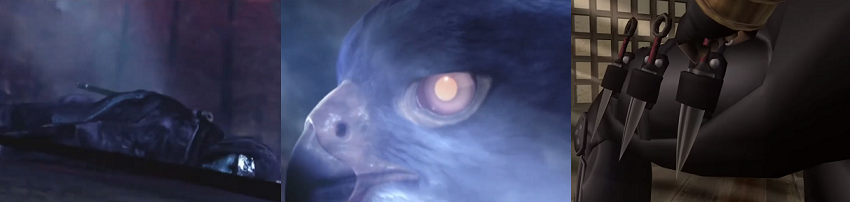
RIP Itagaki.
In Turok 2 you play as a time traveling native American dinosaur hunter. The second level starts off with you riding into battle upon your trusty steed, a stegosaurus with dual mounted automatic grenade launchers, rampaging through a horde of genetically engineered bipedal dinosaurs with laser guns attached to their arms. If that was the plot of a non-comedy movie I’d roll my eyes, but it hits differently when I get to be the guy doing the crazy fun stuff.
I’m almost entirely forgiving of logical inconsistencies in a game, if they are in service of me having more fun. I’ll accept a near infinite stream of random encounters in an RPG, if the combat is good. Only when the combat is a chore do I begin to question the plausibility of a world where three quarters of the population is bandits and I encounter twenty weird demon wolf things on a leisurely stroll between the base of a town and the eccentric inventor’s house on top of a short hill. Frankly, if the combat sucks, I’ll find reasons why the premise makes no sense, even if it largely does hold up logically.
Similarly, it may on paper be weird that in every action game the Big Bad’s underlings all love their boss so much they’re willing to immediately throw down, despite thousands of their coworkers already being killed by the player character, but the alternative is a ten minute long game with just a few combat encounters. Truthfully, the over-the-top silliness of me playing as a one man murder machine isn’t even a problem to be handwaved away, it actively adds to my enjoyment. The crazier the setup, the better, and for the most part I don’t want the game to acknowledge this. Let me be the one to snark.
Circling back around to our Blacktivist twerking the player to death, I do think that, if the joke lands the first time, it will at least remain as a sort of flavour. I’d liken it to a beautiful city in an RPG game. I’ll often stop to take in the sites the first time I play the game. After a few times, I start looking at the city more mechanically, focusing less on the beautiful architecture and landscaping, and more on the traverse times to the important locations. Still, long after the initial awe has subsided, the beauty remains in the background, to be subconsciously appreciated.
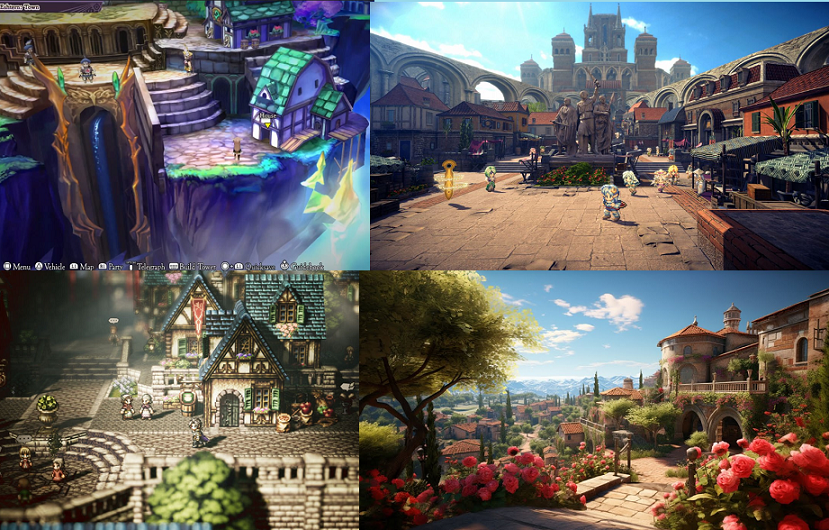
However, when it comes to humour, we can probably do better than a static joke played on repeat. In the Q&A for the talk I mentioned we got into a back and forth about this. Most of the examples of game humour given by the audience involved pushing a game system, usually physics, beyond its means, usually through explosives. Perhaps the most classic example of this is when pigs fly in Halo.
I remember playing this game co-op with my sister back in the day. When we realized that players would respawn with two grenades we took turns killing each other repeatedly, building up a near infinite stash of frag grenades. We’d then drive a warthog above the pile, before detonating them all. Sometimes one of us would get into the warthog and be launched thousands of feet into the air. It was a good time.
I used to play Heroes Of The Storm, a kind of MOBA, and I’d occasionally watch online gag compilations. After a while you start to notice a few patterns, as if it’s a TV show and the same recurring gag keeps coming up. Last episode Kerrigan went halfway across the map after she dashed to a Lili that got simultaneously pushed by Stukov to the enemy base, meanwhile this episode features Varian and Illidan doing pretty much the same thing.
Bodyblocks were great, in part because when players tried desperately to get away they’d stay in place, but their avatar would rotate around really quickly, so you could feel their panic through the screen. That could come from a tank bullying some character inside of a chokepoint, a Butcher or Maiev chain, or Alarak pulling Nazebo into his own wall, whereupon he’s blown up. Or a Sonya trapping characters while Chen’s bashes them against the walls over and over again.
Certain characters featured far more often than others, such as D’Va. Her ult was a very slow, but very large and powerful explosion, and the bomb could be moved around by characters such as Stukov, Stitches, Alarak, Junkrat, Garrosh, and many others. It didn’t hurt that HOTS had a nice ragdoll system for dead enemies, where the most powerful explosions could eject killed characters from the entire arena.
Abathur also featured often, for a similar reason. He could lay mines (almost) globally, and the way you were supposed to use his mines was to spread them out, giving vision and dismounting enemies. However, you could combine them all into one massive super explosion that deleted characters instantly. On top of this, he was incredibly weak, but every now and then it was a good play to throw his fragile slug body into the fray and pimp slap hoes to death. The below video even features two Abathurs having a sort of cripple fight over the objective.
Another theme was that of a character charging up for a big play, only to get shut down immediately. Like Falstad flapping his little wings before flying behind enemy lines only to get instantly polymorphed, stunlocked, and blown up. Part of that comes from knowing how excited the player was before utterly failing, and part of that is the natural comedic timing. In order to appreciate a punchline, there must have been setup. It’s like the Torque Bow, from Gears of War, where there was a good second after being hit before you exploded. So you had that “oh n-” moment before being gibbed.
So there is some variety, but for the most part, similar to what we discussed in the Q&A, the funniest moments from HOTS were usually some variation of explosions being moved to players, players being moved to explosions, or explosions combining together to be far more powerful than intended. That could be from a Dehaka tongue into a built up Probius disruption pulse, a Kael’Thas ult that a Tracer spreads to the rest of her team with a poorly timed rewind, Mei rolling D.Va’s ult into the rest of her team, Stitches pulling someone into ten Abathur mines stacked together, or any other combination, but the theme is the same.
The line between funny plays and good plays is quite fine, which is why I think games should aim for silly, slapstick fun, and not be desperate for outright laughs. It’s certainly funny when someone gets totally deleted by a Muradin haymaker that shoves them right into a combination of Zul’Jin and Ragnaros’ burst ults, and their character model goes ragdolling off the screen. But a play where Muradin’s haymaker simply pushes the enemy out of position whereupon they are quickly killed, or are simply rendered useless for the important part of the fight, is still a lot of fun to pull off even if it won’t make any highlight reels.
The same is true for the funniest single player game I have ever played, Dark Messiah Of Might And Magic. Most of the time the emergent chaos is simply fun to play. Sometimes it’s hilarious. It really is a shame that games never expanded upon the groundwork laid by this title, because it might have the best combat of any RPG ever.
Normally the kick just pushes the enemy back a bit. However, if the game senses that there are spikes, a fire, another enemy, a ledge, or something else interesting behind the enemy it will send them flying. So the player in the above video runs to the window, opens it up, sidesteps the charging enemy before sending them flying down to ground level. They proceed to disable then next enemy by throwing a barrel at them, crush two more by cutting down scaffolding, and kick the survivor into a fire. This isn’t just funny, it’s near optimal play.
This is far from all Dark Messiah has to offer. We haven’t even touched upon the ice spell, which causes the enemies to slip so hard they massively accelerate forwards and land on their heads. Or the pendulum spike traps. Or the destructible floors. Or the throwing rocks with very generous damage. Or the fire that causes enemies to run around without care as to where they’re going, even if it’s off a cliff.
I started the below video from the point where someone releases pendulum trap, and then spends the next fourty five seconds maneuvering the guards into it. Unlike the previous example, this is far from the most efficient way to kill them, especially once he’s down to the last few, yet I totally understand how much fun he’s having. It reminds me of when I played Halo:CE, and would spend minutes getting pairs of hunters to injure each other with their smash attack. One time I got them to kill each other simultaneously. The only thing that could have made it better would be if they had cheesy taunt lines that could be interrupted with an over the top death gurgle.
The pendulum trap example highlights something else, which is that the more the player is the causal agent, the more fun they’re having. Maneuvering into range of the enemy to trigger a funny attack animation is nice. Maneuvering an enemy into leaping at you, only to sidestep and have him crash into another enemy, interrupting them mid taunt and sending them flying into a fire, whereupon they get up and run straight off a ledge, is nicer. Yes, part of that is because it’s just inherently more ridiculous, but people like to work for their meals.
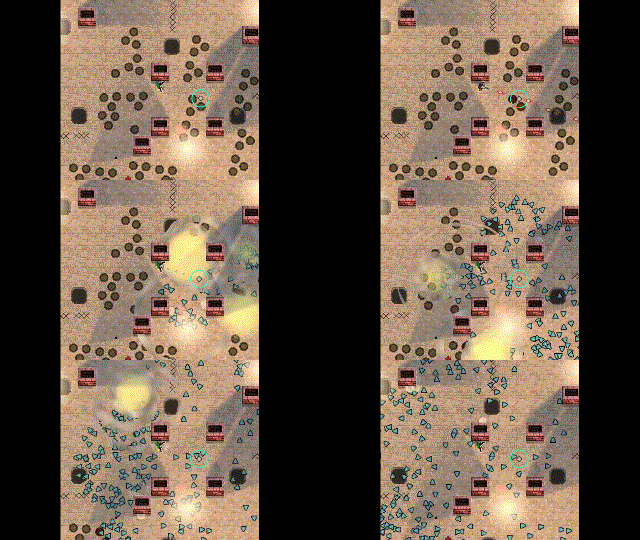
So what part of all this is applicable to Escape From Epstein Island?
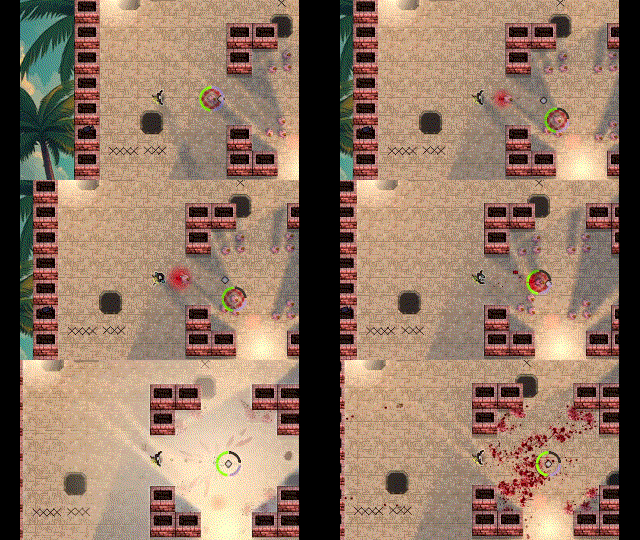
Well, this article is already too long. I’ll get to that in the next part.