
For the previous entry, go here.

SHMUPS INTERLUDE
Twin Stick Shooters are a fairly rare genre, and I’m not a huge fan of any particular examples. I liked Geometry Wars back in the day, and moderately enjoyed Enter The Gungeon, Nuclear Throne, The Binding of Isaac, and Hotline:Miami, but I knew from the start that I’d be making something different. Roguelike mechanics didn’t fit with my vision, and I wanted tactics to be prioritized over mouse dexterity and aiming.
Luckily, First Person Shooters are a dime a dozen, and shmups, while a less popular genre, have solid designs, well iterated on. Since both genres are a kind of shooter, I figured I’d lift some enemies, mechanics, and level design concepts from those games, and with only the tiniest of modifications, it would just work. In reality, it was more of a mixed bag.
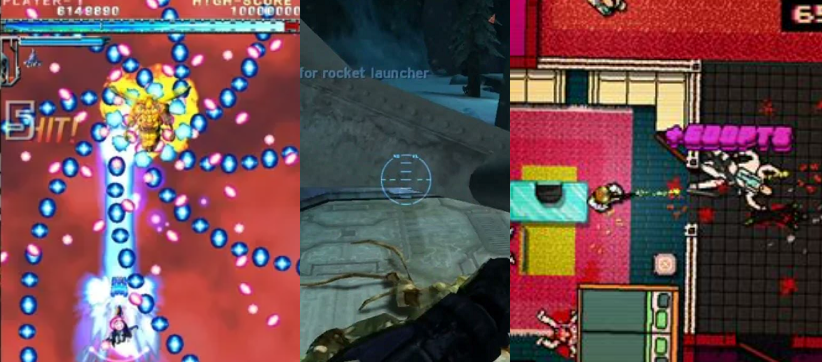
Shmup, FPS, Twin Stick
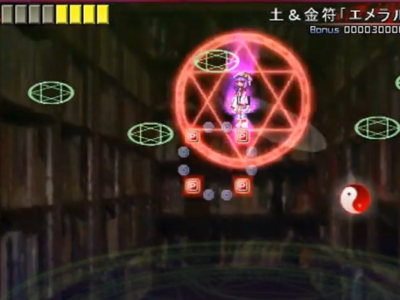
Almost all Shmups are characterized by having no cover, a fixed camera that shows the entire arena, and incredibly slow moving projectiles with tiny hitboxes that one hit kill the player. While much of their designs are dangerous to unthinkingly port to a different sub-genre of shooter, there are some concepts that other genres should steal.
For example, the graphical work that shmup developers have done figuring out how to make the bullets and patterns clearly visible is almost entirely transferable to a top down 2D shooter. Legibility is akin to a science, and many of the concepts, such as saturation levels being as important as colour when separating objects, or object shape implying velocity, are applicable to other games.
Less applicable is the shmup practice of making the player’s hitbox vastly smaller than their visual representation, to the point where the player’s avatar is almost completely divorced from its damageable core. Likewise, visually enormous enemy bullets have miniscule hurtboxes, and move extremely slowly through the screen.
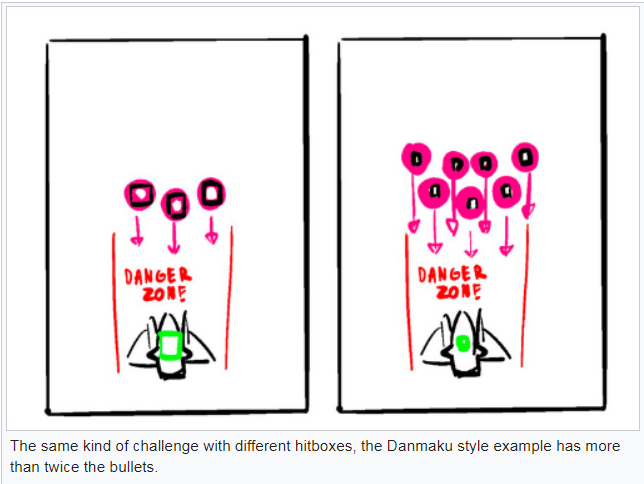
From BogHog’s shmup tutorial linked above.
This is done partly to help the player track the projectiles, and partly because it feels unfair when the player takes damage after grazing the edge of a projectile. As this makes dodging any individual bullet much easier, it would trivialize the difficulty were shmups incapable of compensating by throwing an inordinate amount of one hit kill projectiles at the player with no cover to hide behind.
All these concepts – the lack of cover, the massive amounts of slow moving but tiny projectiles, the instant kills – harmonize well in that genre. The issue with shmups is that all of these design decisions are downstream from their assumption of tight designer control over enemy placement. Shmups even implicitly control the player’s placement on higher difficulties, as you’ll die if you aren’t moving through the level or boss fight in the intended way, with a slight bit of wiggle room. This is neither possible nor desirable in any other kind of shooter, except maybe rail shooters.
In shmups, the player has almost no control over the enemies. Their movement is pre-programmed, and there is no hitstun. The main way the player can affect the enemies is to kill them more efficiently. To a much lesser degree, they can manipulate their firing patterns through skilled macro-positioning.
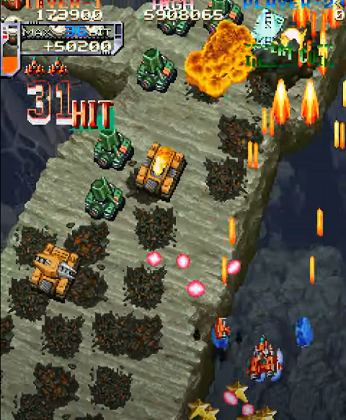
However, this limitation of shmups is what gives them the ability to weave together very complicated bullet patterns. It is therefore fundamental to that genre’s design that the speed of any particular enemy bullet is set quite low, and the size of the bullets is also set quite low. If the bullets were large and fast, the games wouldn’t work, as each individual bullet is akin to a part of a maze.
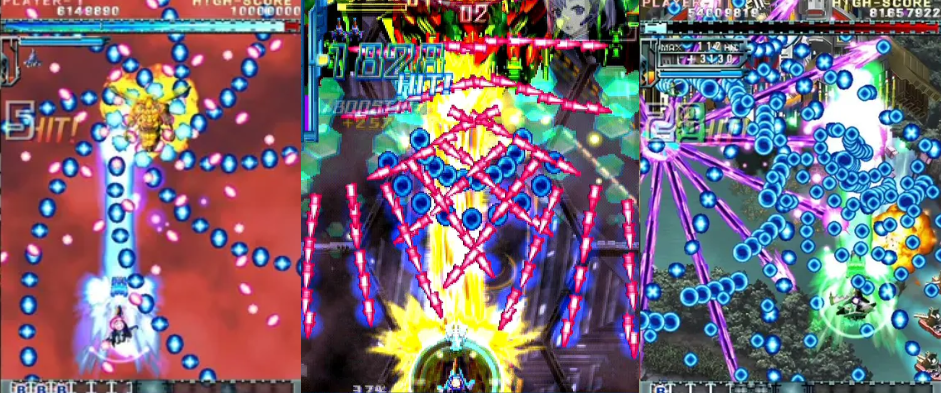
At first glance, copying this seems like a great idea for a twin stick shooter. Dodgeable projectiles almost always lead to deeper gameplay than hitscan weapons, as they add another layer to the positioning/movement. Therefore, it stands to reason that if semi-dodgeable projectiles are good, even slower projectiles must be better. Unfortunately, this is not the case, and I eventually ended up increasing the size and speed of some projectiles by an order of magnitude.
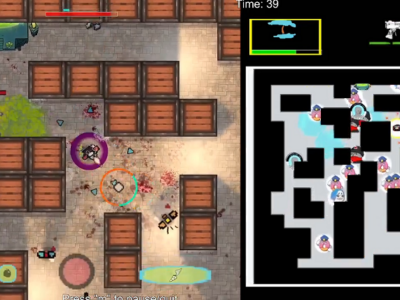
Here’s the difference. In twin stick shooters, much of the player’s skill revolves around manipulating the enemies. While there are a few caveats, enemies are stunned when taking damage, and their positions and states can be altered through the player’s positioning.
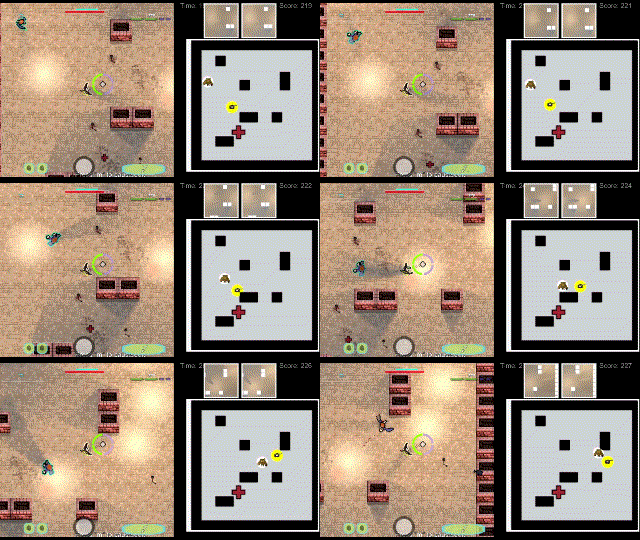
The challenge is doing something like this while dealing with two dozen other enemies.
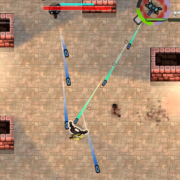
For example, the golem, seen above, starts by charging up its powerful ranged attack. However, the player nudges close enough to trigger its chase state, which can be kept up indefinitely. When it gets within a certain range it leaps at the player. In this case that was exploited to get it to slam into a wall, damaging itself, and putting it into hitstun.
The sniper is another extreme example, as they will stop in place and start charging their shot if they see the player. This charge will be instantly broken if the player pops back behind cover, meaning that you can expose yourself to them for 99% of the time it takes for them to charge their shot, then dip back behind cover for a fraction of a second and repeat the entire process all over again. Similar things can be done for all enemy types. The challenge comes from manipulating the entire enemy army simultaneously.
However, because of the player’s enemy-manipulation abilities, it is not possible to weave the same sort of coherent bullet patterns about the player. Slow moving bullets fired from scattered enemies at effectively random times are not comparable to the tightly controlled and well tuned enemy group or boss firing patterns inherent to shmups. It is instead just a chaotic mess with totally unpredictable difficulty spikes.
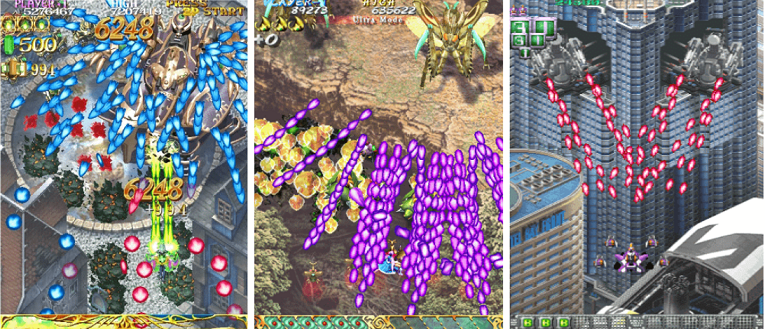
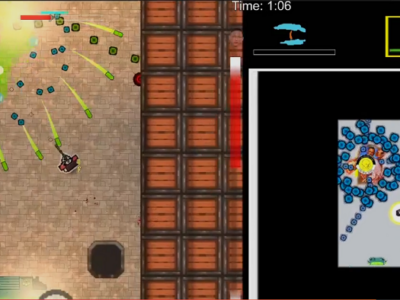
Mass projectile spam, yet ordered.
There are many more projectiles in the images above, compared to below, yet the action below is far less readable, and it is entirely unclear how to navigate the resultant mess. Basic issues with gameplay and legibility arise in twin stick shooters when large numbers of enemies spam projectiles at the player. This is why the game must be designed such that, by the time there are this many enemies firing this many projectiles, the player is already dead.
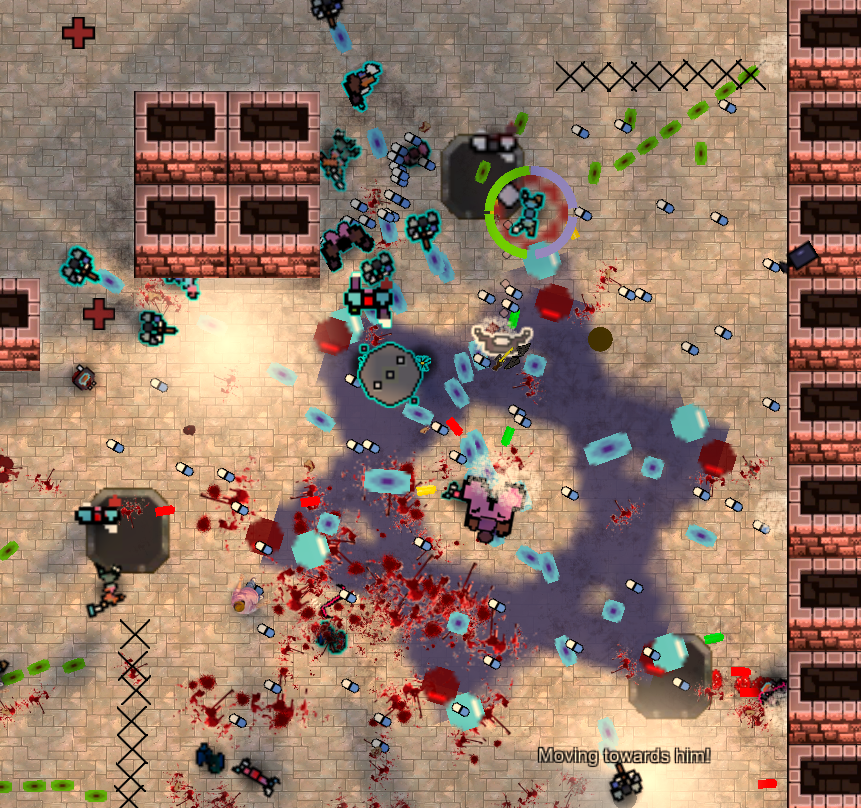
Fewer projectiles, but disordered.
Stacking on top of those problems, shmup battle areas need to be cramped, but a twin stick shooter benefits from a larger arena, so as to make macro positioning more important. This means that the combat naturally happens at greater distances, which makes perpendicular motion exponentially more effective at avoiding incoming fire. Combine that with the default enemy chase behaviour of moving directly to the player, which leads to them being clumped up in the middle of the arena, and mindless circle strafing becomes a dominant, first order strategy.
This is such a problem that it’s easy to give up on projectile based enemy attacks entirely, and fall in love with the hitscan, but this would be a mistake. There are many ways to fix this. Some of those are harsher, such as my placement of police spike strips at the edges of the arena. Some are more dynamic, such as enemy flanking behaviour designed to give up the center of the arena. But crucial is to make the projectiles at least somewhat threatening when close to the player. That means, relative to shmups, big, quick projectiles, with firing patterns I’ll talk about later.
Once we’ve made those changes, it makes sense to give the player a small amount of health, with some way to replenish it. This adds another layer to the gameplay, serving as a kind of resource for the player to dynamically spend or accrue. It also gives us more breathing room when it comes to projectile design, while the player not instantly dying after taking one shot means we can have far more enemies in play at one time, which leads to more complicated scenarios.
Finally, there is no reason not to add cover. Not necessarily in the style of Gears Of War, but rather placing a few objects that the player can use to temporarily shield themselves from certain attacks. While this would probably break a shmup, weaving through cover adds another layer of dynamic decision making, and therefore depth, to the game.
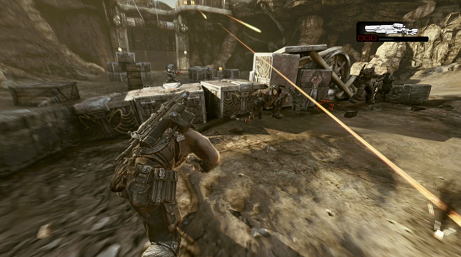
There is a sliding scale in shooter design. On one end we have cover shooters with hitscan enemy weapons, large amounts of recharging health, and tons of cover. On the other, we have shmups with huge quantities of ultra slow moving tiny (hurtbox) projectiles that kill in one hit, and zero cover. Great games can be made in both genres, but it is my contention that something better than both can be found in the middle.
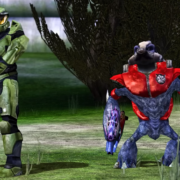
I’ve been trying to pull that off in the twin stick genre, and figured that there was no reason why someone with more resources couldn’t do that in an FPS. It recently occurred to me that we already had that game, albeit in prototype form. It was called Halo, and while its corpse was recently dug up and molested by 343 Industries, it started going off the rails as soon as its sequel, and the games industry never replaced that archetype of shooter with anything else.
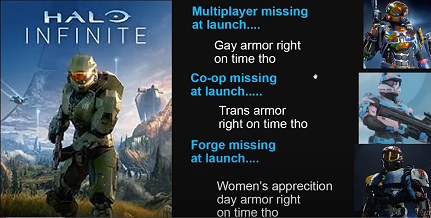
It may seem like I’m unduly harsh towards Bungie, but this is only because the Pronoun People of 343 Industries fail in ways that are politically interesting, but artistically disinteresting. It’s similar to how you can dislike and criticize Tolkien all you want, but to do anything other than point and laugh at Amazon’s Rangs of Power is to embarrass yourself. One is flawed art, the other is slop, beneath contempt.
The most obvious effect of the zionist takeover of the gaming industry is pozzed games with microtransactions. Less obvious is the stultifying effect on game design. Every human endeavour advances through learning from the successes and mistakes of their predecessors. If we have seen further, it is because we stand on the shoulders of giants, and Halo-era Bungie was one of those giants.
So keep in mind, as I harshly critique Jaime Griesemer, that I have a ton of respect for him as a creative. His work on the early Halo games was inspired, especially with respect to the multiplayer, and I’ve gotten a lot out of the three talks he’s given at GDC. I should also note that Halo 2’s development was, by all reports, a complete mess, and most of that isn’t on the design team.
Bungie made two technical decisions which backfired on them. The first was pursuing shadow volumes, which borked their lighting model. The second, and I’d argue far more serious mistake, was attempting to create far larger battles with more complex AI, something the hardware was not ready to handle.
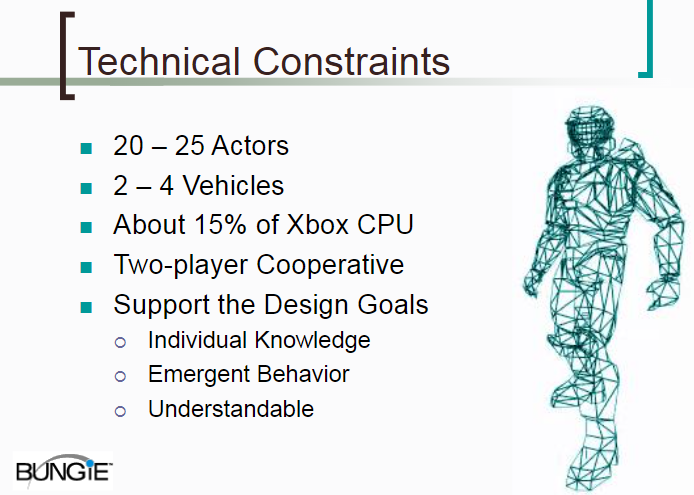
From Griesemer’s talk about CE.
The original Halo ran on an XBox that proudly featured a single core pentium 3 derivative running at less than 750 MHz. By no means was this a powerful chip, and CE already had an inconsistent framerate in many places. There simply wasn’t any headroom left to push for the sequel, but push they did.
The software side of their upgraded AI system worked beautifully, and they became the first studio to ship a game with behaviour trees, now the standard in the industry. Unfortunately, in a situation similar to shadow maps, the software could be written long before the hardware could execute.
Late in development the AI count was cut dramatically, so as to ship a game that could barely run at 30 Hz. As this made the game vastly easier, they had to massively increase the challenge of any particular enemy to maintain the difficulty. This was an incredibly difficult task, especially under time crunch. Unfortunately, their solutions broke the game.
JAIME GRIESEMER’S TALK (Finally)
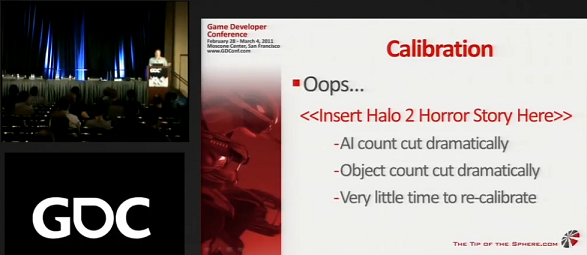
They also had to cut the amount of cover, which exacerbated the issues we’ll discuss later.
While there is a particular strand of modern gamer who has had their brain so rotted by FromSoft memes that they actually defend sniper jackals, the majority still correctly describe Halo 2’s legendary difficulty as cheap, capricious, unfair, and unfun. While the jackal snipers are the most obvious negative example of their “just crank up the difficulty of every enemy,” strategy for balancing legendary, they are also fairly rare.
More important are the changes to the elites, specifically the changes to their main weapon of choice, the plasma rifle. It may seem silly to focus in so much on just one weapon, but Griesemer himself would agree.
4:52 (Jaime Griesemer speaking)
So you know looking back on Star Wars you thought it was about Luke, and really it’s all about Darth Vader? Looking back on Halo we could have named it Plasma Rifle because that’s what it’s all about.
Griesemer claims that the plasma rifle bolt was the most common enemy projectile in Combat Evolved. I’m not sure about that, but I agree that it is the biggest factor for difficulty, as well as Halo’s most most iconic and flavourful weapon.
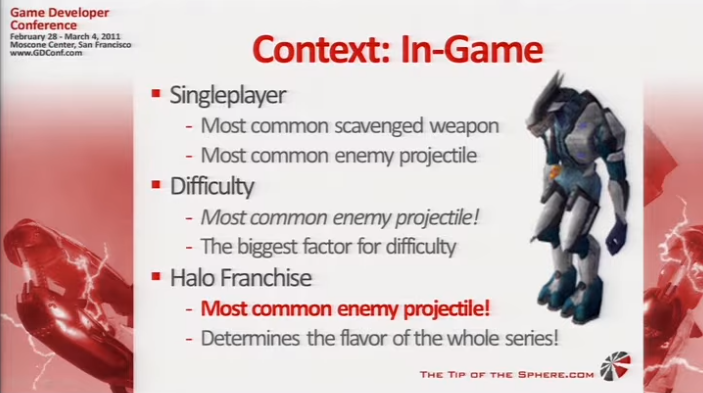
Griesemer’s argument that the plasma rifle was broken in Combat Evolved is a result of confused, contradictory thinking. Later in the talk he claims that the plasma rifle should have effectively been an undodgeable hitscan weapon. However, early in the talk he quotes from the Halo:CE paper design, which says of the plasma rifle “The primary trigger is an instantaneous visible beam which fades quickly,” and says the following.
9:10
Which is not how it ended up at all, because it’s not fun to get shot with something that travels instantaneously.
There is a weird conflict in this talk between Griesemer’s intuition, which is largely correct, and the logical part of his brain, which routinely whiffs. Above he praises the changes they made to the plasma rifle during the development of Combat Evolved, specifically because they made it dodgeable. Later, he justifies changing the plasma rifle into a glorified hitscan weapon, because dodging is bad. This claim is proven with arguments that are either irrelevant, or outright false.
23:55
[On Normal difficulty] we found the players could dodge the plasma bolts, which felt really good for them, but it had some unintended consequences in Halo 1. First, they were fighting out in the open, so they saw more of the enemy behaviours, which is good, but they also died without seeking cover because they wanted to only fight out in the open, which was not so good.
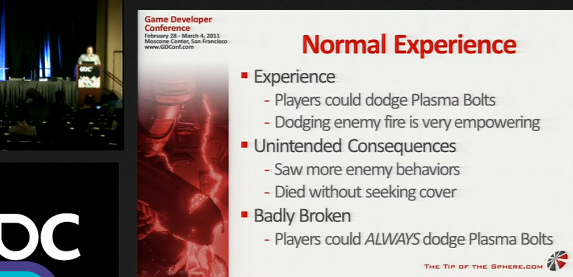
The number one degenerate strategy in the Halo games is cowering behind cover. Almost all of the game mechanics reward this behaviour. Your shields take six seconds to start recharging, and on the lower difficulties recharge very slowly once started, encouraging you to cower behind cover until they’re back up again. While you’re twiddling your thumbs, you might as well reload your weapons, as there is little advantage to doing that out in the open.
Meanwhile, flood excepted, the enemies are massively overpowered at forcing the player into cover, yet massively underpowered at flushing them out. Most arenas are not properly designed to allow flanking, the enemies are not nearly aggressive enough while lacking the tools to consistently damage a cowering player from afar, and there is no meta-mechanic, such as a timer, that counters this behaviour on a macro level. The closest the game gets to countering this behaviour is spawning infinite waves of flood, which has its own problems, but does necessitate that the player eventually aggressively moves through the encounter.
For most of the game the optimal strategy is to pop out of cover, kill or at least hurt a grunt or two, then go back behind cover and wait roughly ten seconds for your shields to fully recharge before popping back out again. Repeating this tedious loop until all the enemies were dead is something you’re almost forced to do in many encounters on Legendary difficulty.
I can believe that Griesemer saw all sorts of unusual things when watching playtesters. For all I know, there really was an epidemic of people Rambo’ing their way through the game on normal difficulty. If so, I think he took the worst possible lesson from that. If people are choosing to die over and over again rather than embrace the tedious optimal play of hiding behind a rock for ten seconds, ten times per encounter, the takeaway should probably not be to punish them even more for playing the fun way.
24:17
So basically you can always dodge the plasma rifle in Halo, and this is why. If you aim directly at the player, as an AI, and the player is moving, you’re going to miss.
It is simply not true that you can always dodge the plasma rifle, and saying so betrays a misunderstanding of shooter fundamentals. The plasma rifle, like all dumb projectiles, can only be dodged if the player commits to strafing that particular enemy, and is at a far enough distance, which they often aren’t. In fact, one of the biggest problems with many encounters, like almost all onboard The Truth And Reconciliation, is that the close quarters combat leaves the player with no way to dodge the incoming fire.
To throw Jaime a bone, it is true that in some wide open areas, such as found on the levels “Halo,” and “Silent Cartographer,” it can be very difficult for the enemies to hit the player. In those cases you see a classic problem not with projectiles, but with the most naive implementation of firing patterns. If the enemies stupidly aim directly at the player, they will miss every shot, provided the player is strafing. Even that claim needs an asterisk, as flanking enemies massively complicate this, but it is a legitimate problem.
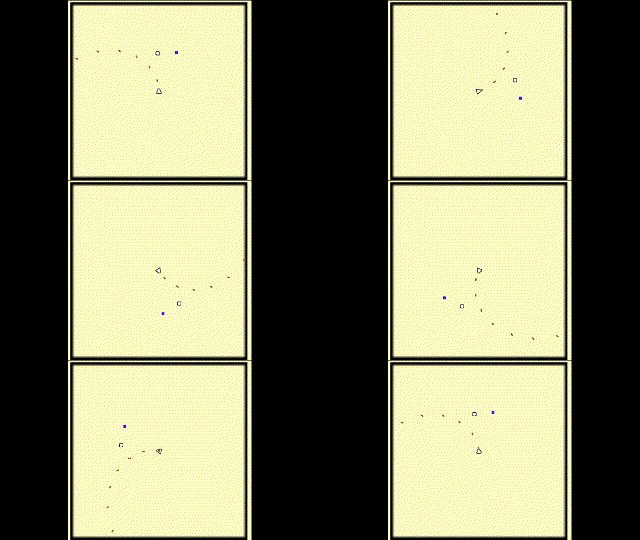
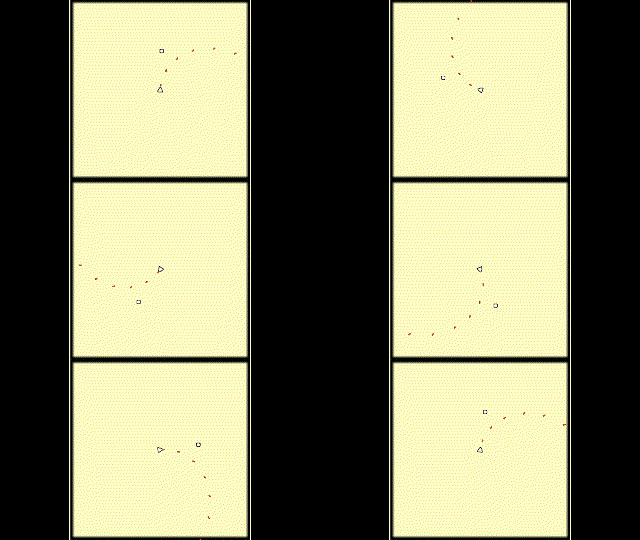
The purple square represents where the triangle would need to aim in order to actually hit the white square.
There are a number of naive ways to fix this problem, all of them bad. Increasing the speed of the projectiles may work to fix one encounter, but break the others fought from closer distances. The same is true for increasing the size of the projectile or player hitboxes, which, as we discussed in the shmups section, also hurts the gamefeel. The worst solution is to diminish the player’s speed, which needs to be set independently of any specific enemy projectile.
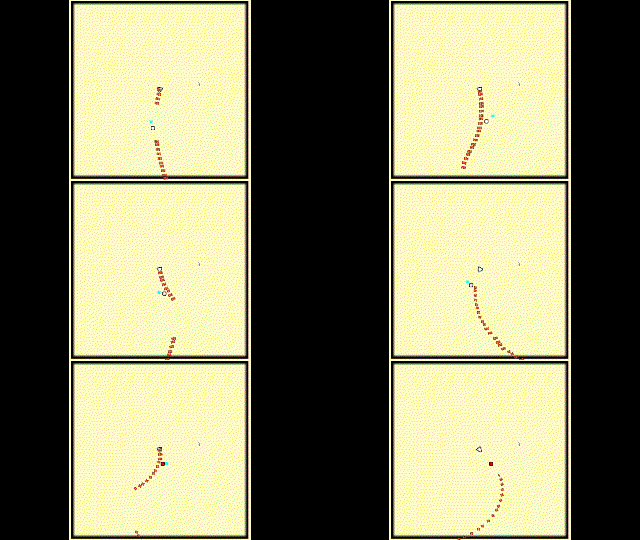
A better solution, stolen from shmups, is to have the enemies shoot multiple projectiles out of their guns. This also creates a gradient of damage. From far distances, the player can remain completely safe, if actively strafing. At medium distances, they’ll take one third the damage, as they can no longer completely out strafe the incoming shots. At point blank, or if they don’t bother strafing, they’ll take full damage. As a result, there is more nuance in the strategy, and less of a harsh punishment for being one pixel too close to avoid damage.
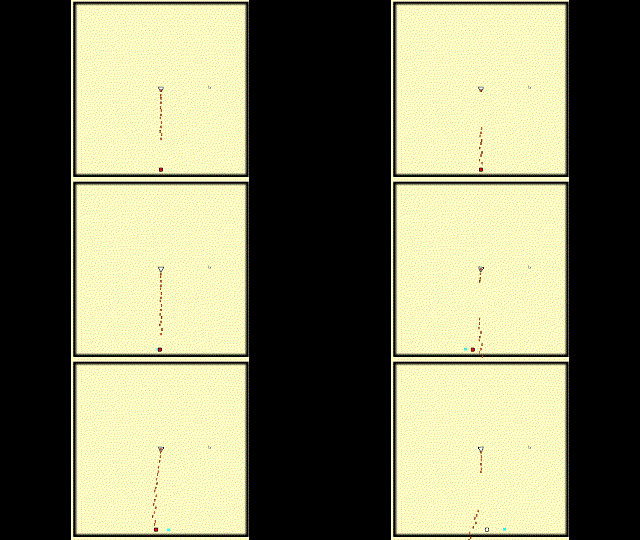
Randomness, or in this case pseudo-randomness, is something that should probably be done anyway for visual purposes, as the slight randomness makes the combat feel more frenetic and real. The mechanical benefit is that it makes the bullets more of a threat at longer distances, as the cloud of bullets becomes more spread out over time.
Another interesting way to make the projectiles a more serious threat at distance, while not making them too un-dodgeable in close, is to have them accelerate after leaving the muzzle.
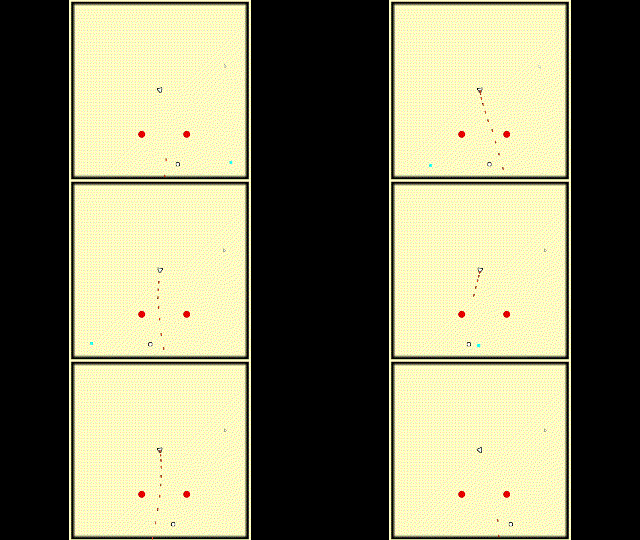
However, by far the best way to fix this problem is something Griesemer dismisses out of hand.
You could solve that by trying to lead. The problem is, if they zigzag at all, you miss by even more.
This is only true in the context of an individual shot. When looking at a salvo of bullets, which the elites always shoot, this is very much not true.
Below our triangle enemy has been programmed to fire a salvo of ten bullets. He starts the salvo by aiming directly at the player, and linearly progresses to aiming with a proper lead. Not only do the last two or three shots hit the player, there is no reasonable way for them to zigzag without getting hit by at least one shot, probably more.
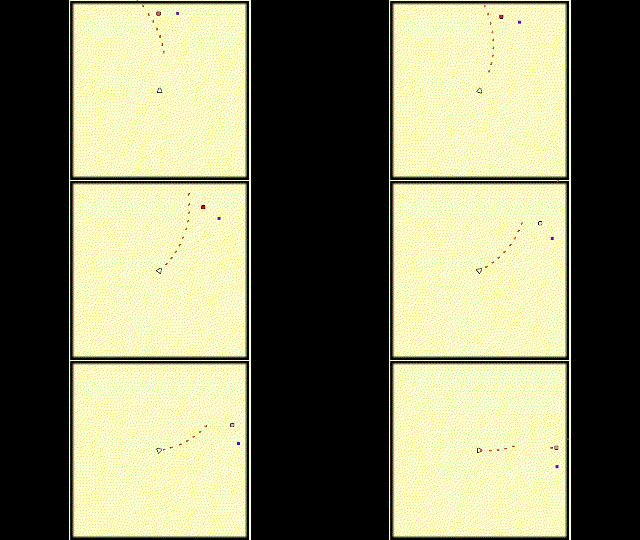
These firing parameters can be endlessly tweaked to best fit the particular needs of the game.
But perhaps more importantly, even if the shot patterns are designed in such a way that the player could somehow zig zag through them without taking damage, that effectively forces the player to stay in roughly the same place. It seems very odd to dismiss projectiles that trap the player out in the open as simple missed shots.
The Covenant have grenades, fuel rod cannons, snipers, and needlers, all of which excel at killing players that trapped out in the open. Even grunts with plasma pistols are very effective at this, given large enough numbers, covering various angles, and at close-medium distance. If the elites cut the player off from returning to cover, even for a just a few seconds, there is a good chance they signed the player’s death warrant, even without doing any damage themselves.
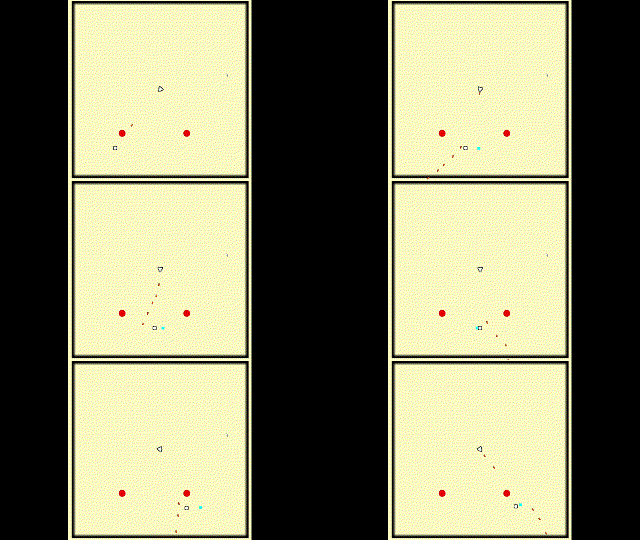
An easy to avoid plasma rifle burst pattern, that nevertheless forces the player to be exposed for about 2-3 times as long. Light blue square represents predicted aiming point.
Synergistic combined arms is how enemies should be designed. Each enemy should be given various strengths and weaknesses, that demand the player dynamically adjust their tactics based on the combination of enemies, their positions, and various other factors such as the player’s weapon and shield status, objectives, etcetera. Not only is this great for gameplay, it also makes the enemies feel smarter, in large part because they actually are. An elite who deliberately fires in such a way as to cut you off is legitimately more intelligent than one who doesn’t, and the same goes for army that fights well together.
There are a lot of valid directions Bungie could have taken for Halo 2, but the evolution of the plasma rifle’s role as a weapon that forces the player out of cover would have made a lot more sense than one that forced the player into cover. Remember, the sandbox already suffered from cowardly, tedious play being optimal. They didn’t need to punish players strafing out in the open, but that’s exactly what they did, and then they praised themselves.
If your projectile is dramatically slower than the player this is not a solvable problem, and if you know that this is the case in Halo you can break the game on pretty much every difficulty level in every encounter, so this is bad.
No, a projectile does not need to be slower than the player for it to be dodgeable. Projectiles more than an order of magnitude faster than the player may be dodged trivially, provided enough distance is kept between the weapon, and the hitboxes are fairly small. You just need better a better firing algorithm than the weird non-tracking and non-leading fan pattern programmed into the Halo:CE elites.
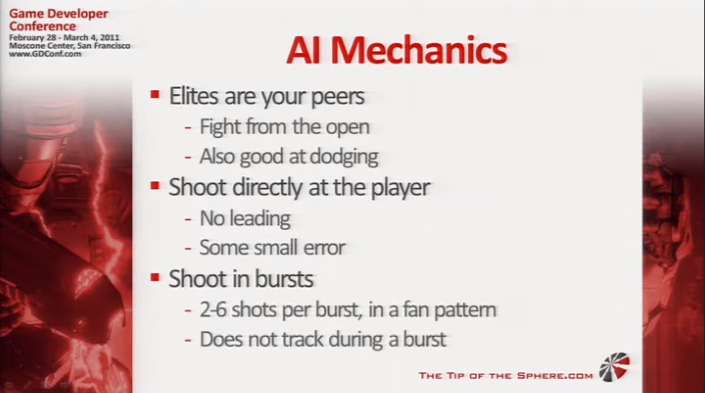
Griesemer’s has one last justification for turning the plasma rifle into a hitscan weapon that murders the player within one second of leaving cover. In a bizarre inversion of FromSoft drones confusing punishment with difficulty, Griesemer confuses difficulty with punishment. He argues that the plasma rifle was equally hard to deal with on all difficulty levels, because each individual shot was just as easy to dodge.
26:00
The way this was badly broken was that dodging was not actually any harder [on higher difficulties]. On normal you could dodge back and forth and every projectile would miss you, and if a couple hit you that was fine, you just take cover. On legendary you could dodge back and forth in the exact same way, the same number of bolts would hit you and they would kill you. So we weren’t actually making the game harder, we were just making the game more punishing.
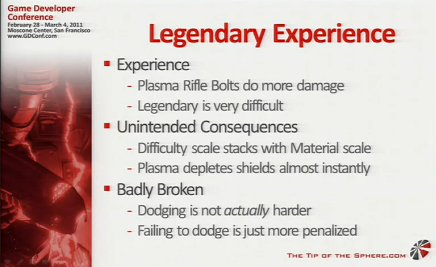 I think I understand what Griesemer was trying to say. In the gif below, it barely matters whether those bullets kill the player in one hit, or in one hundred. Once the player learns to circle strafe forever, all damage is avoided. However, in the actual game of Halo, enemies doing more damage absolutely makes each encounter more difficult, mainly because there is not one single enemy in play.
Imagine a scenario where there is a room with an elite on one side, and a bunch of grunts and jackals on the other. If you’re playing on normal, you probably have enough health to ignore whatever the elite is doing, tank all his rifle shots, and deal with the other side at your leisure. On legendary, if you try that you’ll just die, so you have to manage both sides of the room at the same time.
Maybe that means positioning/moving in a way that never exposes your back to the elite for more than a second. Maybe that means throwing a grenade at the elite so he dodges away, buying you some time. Maybe that means switching off the grunts and jackals, and focusing on the elite. Maybe that means some combination of all the above and more. Whatever the specific solution, it’s undeniably more difficult, because the lower your health the lower your margin for error.
The same is true for any other game with depth. Chess is pretty easy when you’re playing someone who is bad. When you’re playing Magnus Carlsen, you get punished for your slight inaccuracies and lose. The Halo equivalent of a “slight inaccuracy” might be, for example, unnecessarily exposing yourself to an elite. Said elite doing more damage on higher difficulties absolutely makes the game more difficult.
I do like that Griesemer differentiates between difficulty and punishment, but in this case he’s misappropriating the term “punishing,” as is commonly understood in game design. Typically, when people say a game is punishing, they mean it wastes the player’s time, not penalizes mistakes more harshly. Overloading this term only pollutes the already pretty miserable game design discussion.
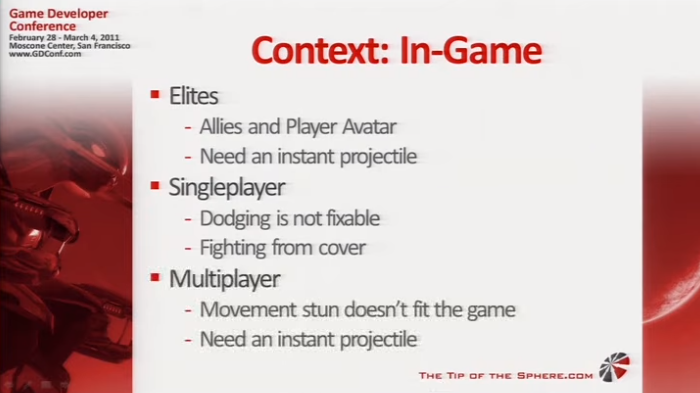
Throughout the rest of his talk Griesemer triples down on his erroneous claim that dodging is not fixable, a confused and incorrect statement any way you look at it. Worse still, he repeatedly pats himself on the back for reinforcing the most broken aspect of Halo’s sandbox, the lack of punishment for hiding behind cover.
49:10
The more you push a Halo encounter, the more it pushes back, which rewards risk, because if you push really hard you can break through very fast, as long as you can handle how hard it’s pushing back at you. But at the same time it forgives failure, so as soon as you withdraw, it withdraws.
You’ll notice in Halo the AI don’t really chase you very much, and we don’t punish you at all for risking and then failing and running away, your shields come back, your health comes back. The AI resets basically.
Letting the player hide behind cover unabated is the complete opposite of rewarding risk. It instead rewards the tedious, overly cautious play we’ve already talked about ad naseum. Also, you can’t always reward risk, or by definition it is not risk. You can reward aggression, which is something that the Halo games absolutely do not do, especially Halo 2.
36:00
Why [the plasma rifle in Halo 2] was totally broken was because of the suppressive fire I talked about earlier. The AI would over focus to a ridiculous degree.
Griesemer bemoans a tactic known in the Halo community as “redirection.” This is where you exploit the AIs tendency to overshoot at the last place they saw you. Basically, peak out one side of cover, take a few potshots, peak out the other side, and so on and so forth. This video, started at the right time, explains it pretty well.
Once again, Griesemer’s intuition gets it right, while his conscious mind fails him. On some level, he understands that it is not scintillating gameplay to go back and forth from one side of cover to another, but he doesn’t understand the real issue, which is the player being trapped behind cover in the first place.
Redirection is a perfectly valid tactic, and would add depth to the game were it not the only valid tactic. Had the game been more balanced between cover and strafing, redirection would be just one of many tactics good players would situationally employ.
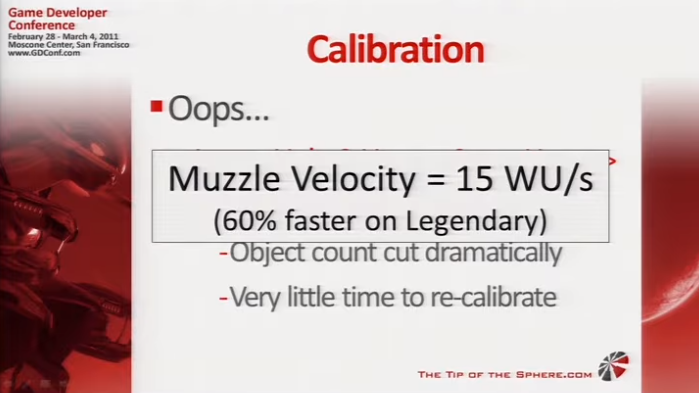
Griesemer’s final justification for making the plasma rifle bolts not just faster than on CE, but massively faster on Legendary difficulty specifically, is that he believes this makes the game itself faster.
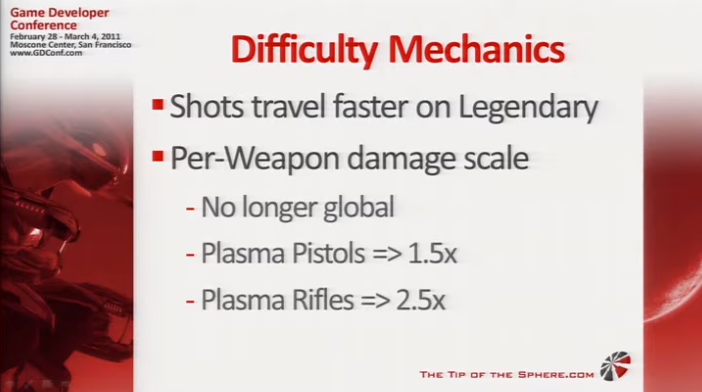
48:35
I believe the right way to make a game harder is to make it faster. So the same experience slowed down becomes easy. The same experience sped up becomes harder. The projectiles go faster, the AI firing delays get shorter, and the entire combat cycle gets faster, so it’s probably like 22 seconds of fun or something like that.
There are a lot of ways to make a game harder, and the default for something like Halo would probably be adding a few more enemies per encounter, and letting them deal more damage, something Griesemer is opposed to due to his misunderstanding of difficulty and punishment. However, I agree that speeding things up is a valid method of increasing difficulty. After all, more mistakes are made by chess masters playing blitz than under classical, hours long time controls, and most people find it more exciting to watch.
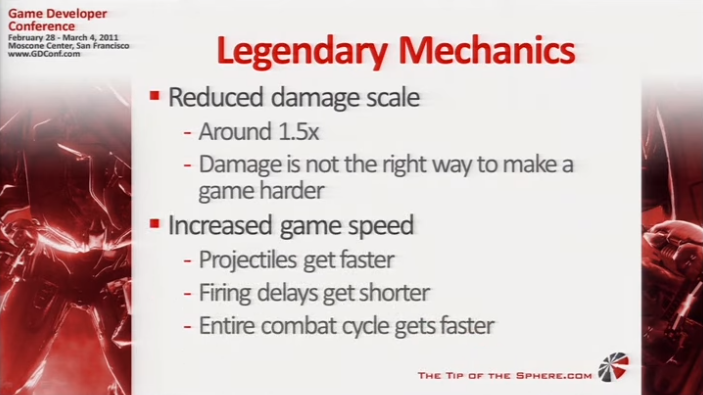
Unfortunately, turning the plasma rifle into a hitscan weapon doesn’t make the game faster, it just breaks the sandbox. If Griesemer wanted to make the game faster, he should have screwed around with the internal time of the game engine, and actually made the game faster. Ironically, faster projectiles actually makes the game a lot slower, and drags the average combat encounter out, as it reinforces the tedious process of playing peakaboo from cover as previously detailed.
CONCLUSION
I’ve given a few talks of my own, all hosted by the Nationalist Media Conference. I’ve also written plenty of articles on my game, and design more broadly. In many of those articles or talks I confidently proclaimed some triumph of design that, in hindsight, was illusory. Upon closer inspection, many solutions turned out to be at best band-aids, and sometimes complete duds. The most glaring example is me “finally removing” mindless circle strafing, something I’ve done on about six different occasions now. To be fair, I did finally get a handle on this, but was huffing copium for a long time.
We all have blind spots, especially towards our own work. We all want our design ideas to work flawlessly, and there is an easy bias towards believing it so. Griesemer is far from the only designer to do this, or the worst offender. However, he should serve as a warning sign for how badly one can misunderstand their own game, and a reminder that sometimes, our intuition can be more accurate than our conscious mind.
Now back to actual development.